KS Learning can provide extra lessons for maths from gcse maths tutors in London and help with gcse maths past papers, gcse maths revision notes, and gcse maths revision worksheets. Maths private tuition at its tuition centre can improve maths knowledge and performance through maths lessons, mathematics tutorials and maths tuition Twickenham.
| Question | Answer |
|---|---|
| Name the components of the circulatory system. | the blood, the blood vessels, and the heart |
| What is the liquid in the blood called? | plasma |
| Name the components of the blood. | plasma, red blood cells, white blood cells, platelets, and many disolved substances |
| How much blood does the average person have? | 4.5 to 5 litres of blood |
| What colour is plasma? | it is a yellow liquid |
| What is the role of plasma? | to transport cells and substances around the body |
| Name the main substances that are carried by the blood. |
• carbon dioxide waste is carried to the lungs • oxygen is carried to the body • hormones and enzymes distributed to different parts of the body • urea produced in the liver is carried to the kidneys to be removed from the blood • digested food pass into the blood from the small intestines and are carried to the cells of the body |
| How many red blood cells are there? | about 5 million in each cubic millimetre of blood |
| What do red blood cells do? |
• they pick up oxygen at the lungs and deliver it to the cells where it is needed • they collect carbon dioxide from the cells and deliver it to the lungs to be expelled from the body |
| Describe the adaptations of the red blood cells. |
• they are biconcave to increase surface area • they contain red haemoglobin that carries oxygen • they have no nucleus making more space for haemoglobin |
| Describe the reversible reaction between oxygen and haemoglobin. |
• haemoglobin combines with oxygen at the lungs to make oxyhaemoglobin • oxyhaemoglobin breaks down into oxygen and haemoglobin at the cells |
| Compare the size of red and white blood cells? | white blood cells are much larger than red blood cells |
| Compare the number of red and white blood cells. | there are fewer white blood cells than red blood cells |
| What is the role of white blood cells? | they form part of the body's defence system |
| Name the three functions of white blood cells. |
• some produce antibodies; these white blood cells are called lymphocytes • some produce antitoxins • some engulf and digest bacteria and viruses; the process is called phagocytosis |
| Name the process of engulfing and digesting pathogens. | phagocytosis |
| Name the white blood cells that perform phagocytosis. | phagocytes |
| What are platelets? | small fragments of cells |
| What is the role of platelets? | they are key in clotting blood at the site of a wound |
| What is blood clotting? | a series of enzyme-controlled reactions that convert fibrinogen into fibrin |
| What happens as a result of the blood clotting process? | fibrinogen is converted to fribrin which forms a network of protein fibres that capture red blood cells and platelets which dry to form a scab |
| What does a scab do? |
• stops bleeding • protects the new skins as it grows • stops bacteria entering through the wound |
| Do white blood cells have a nucleus? | yes,they have a nucleus |
| Do red blood cells have a nucleus? | no, they do not have a nucleus |
| Do platelets have a nucleus? | no, they do not have a nucleus |
| Question | Answer |
|---|---|
| Name the smallest blood vessel in the body. | a capillary |
| How far away are cells from capillaries? | every cell in the human body is within 0.05mm of a capilliary |
| Name the different types of blood vessels | arteries, veins, capillaries |
| What is an artery? | a blood vessel that carries blood away from the heart |
| What is a vein? | a blood vessel that carries blood to the heart |
| What is the colour of oxygenated blood? | bright red |
| What do arteries do as blood passes through them? | they stretch as blood is forced through them and go back to shape afterwards |
| What do you feel as the pulse in your blood vessels? | the arteries stretching and returning to shape as the blood is forced through them |
| Describe the walls of an artery? | they are thick containing muscles and elastic fibres |
| Why is it dangerous to cut an artery? | blood in an artery is under pressure so will spurt out rapidly if cut |
| What is the colour of deoxygentated blood? | a deep purple-red |
| Can you feel a pulse in an vein? | No, only in arteries |
| Describe the walls of a vein. | they have thinner walls than arteries |
| Why do veins often have valves? | to prevent the back flow of blood because blood pressure is low in veins |
| How do the valves of the vein work? | they open when blood is forced through the veins and close when it runs back |
| How is the blood squeezed back to the heart? | by the action of the skeletal muscles? |
| How are arteries linked to veins? | by a huge network of blood vessels called capilliaries |
| Describe the structure of capillaries. | they are narrow with very thin walls only one cell thick |
| Why do capillaries have a thin wall? | to allow substance like oxygen diffuse easily out the blood and carbon dioxide diffuse easily into the blood |
| What is the space inside blood vessels called? | the lumen |
| What type of circulatory system is found in mammals? | a double circulatory system |
| What is meant by double circulation? | blood leaves and travels to the heart twice through two separate loops to circulate around the whole body |
| Describe how the blood moves through the double circulatory system? | from the heart to the lungs and back to the heart, then from the heart to the body and back to the heart |
| What does the blood collect and release on its journey around the double circulatory system? |
• in the lungs oxygen is collected and carbon dioxide released • in the body carbon dioxide is collected and oxygen released |
| Describe how the blood provides oxygen to the body |
• oxygen diffuses from the lungs into the blood • the blood travels from the lungs to the body • oxygen diffuses from the blood into the cells |
| Describe how the blood facilitate the removal of carbon dioxide from the body |
• carbon dioxide produced by the cells diffuses into the blood • the blood travels from the cells to the lungs • carbon dioxide diffuses from the blood into the lungs |
| Question | Answer |
|---|---|
| Name the organ that pumps blood around the body. | the heart |
| How many times a minute does the heart beat? | about 70 times a minute |
| How many pumps in the heart? | two |
| How many chambers does the heart have? | four |
| Name the four chambers of the heart. | the right atrium, the left atrium, the right ventricle and the left ventricle |
| Where does blood enter the heart? | the top chambers of the heart called the atria |
| Where does blood leave the heart? | the bottom chambers of the heart called the ventricles |
| What does the vena cava do? | it carries deoxygenated blood into the right atrium of the heart |
| What does the pulmonary vein do? | the pulmonary vein brings oxygenated blood from the lungs into the right atrium |
| What happens when the atria are full? | the atria contract together and force blood down into the ventricles |
| Why does blood not flow back from the ventricles into the heart? | valves close to prevent back flow |
| What happens when the ventricles are full? | the ventricles contract and force blood out the heart |
| Name the blood vessel through which blood leaves the heart for the body. | the aorta |
| What leaves the right ventricle? | the right ventricle forces deoxygenated blood out through the pulmonary artery to the lungs |
| What leaves the left ventricle? | the left ventricle forces oxygenated blood out through the aorta around the body |
| Why does blood not flow back into the ventricles? | valves close to prevent blood flowing back |
| What is the importance of the heart valves? | it ensures that blood flows in the right direction |
| What is the main tissue in the walls of the heart? | the walls of the heart are almost entirely muscle |
| How is the muscle of the heart supplied with oxygen? | the coronary arteries |
| What instrument does a doctor use to listen to the beat of the heart? | a stethoscope |
| What causes the sound of a heart beat? | the sound of the valves closing in the heart |
| Which muscle wall is thicker? | the muscle wall of the left ventricle is much thicker than the wall of the right ventricle |
| Why is the muscle of the left ventricle thicker than that of the right ventricle? | the left ventricle needs to develop a high enough pressure to push the blood all the way around the body |
| What happens to the coronary arteries in coronary heart disease? | they become narrow reducing the blood flow to the heart muscle |
| Name a common cause of the narrowing of the coronary arteries. | a buildup of fatty material on the lining of the vessels |
| What is the impact of reducing blood flow through the coronary arteries? | less oxygen reaches the heart muscle causing pain, a heart attack or even death |
| How is coronary heart disease often solved by doctors? | using a stent |
| What is a stent? | a metal mesh cylinder that forces the vessel open to allow better blood flow |
| How is a stent inserted? |
• the collapsed stent is inserted into position with a deflated balloon inside • the balloon is inflated expanding the stent so that it opens the blood vessel • the balloon is deflated and removed leaving the expanded stent in place |
| Name an alternative to using a stent for a blocked artery? | heart bypass surgery |
| What is heart bypass surgery? | doctors replace the narrow or blocked arteries with vein taken from other parts of the body |
| What are the advantages of using a stent? |
• it is cheaper than heart bypass surgery • it does not require a general anaesthetic |
| When is heart bypass surgery appropriate? | when the arteries are so badly damaged or blocked that a stent cannot open them to allow blood flow |
| What are the disadvantages of heart bypass surgery? |
• it is very expensive • it requires general anaesthetic which involves risks |
| Name a popular treatment for people at risk from cardiovascular disease. | statins |
| What do statins do? | they reduce cholestrol levels which slows down the rate at whch fatty material is deposited in the coronary arteries |
| Question | Answer |
|---|---|
| What can go wrong with heart valves? | they can start to leak, or become stiff not opening properly |
| What is the main cause for heart valves going wrong? | they have to withstand a lot of pressure |
| Name some of the symptons of leaky heart valves. | breathless and without treatment, death |
| What can be done about a leaky heart valve? | doctors can operate and replace the faulty valve with a mechanical or biological replacement valve |
| What are mechanical valves made from? | materials such as titanium and polymers |
| What is the main advantage of mechanical valves? | they last for a very long time |
| What is the main disadvantage of mechanical valves? | the patient needs to take medication for life to prevent blood from clotting around the valve |
| Where do biological valves come from? | they are based on valves taken from animals such as pigs and cattle, or even human donors |
| What is the advantages of biological valves? | the work extremely well and the patient does not need to take medication for the valve |
| What is the disadvantage of biological valves? | they only last 12 to 15 years |
| What is the resting rate of a healthy heart? | around 70 beats per minute |
| What controls the beating of the heart? | a group of cells (a natural pacemaker) in the right atrium of the heart that keeps the heart beating regularly |
| What happens if the natural pacemaker stops working properly? | the heart will beat too fast or too slow |
| What happens if the heart beats too slowly? | the person will not get enough oxygen |
| What happens if the heart beats too fast? | it will struggle to pump blood properly |
| How can problems with the rhythym of the heart be solved? | using an artificial pacemaker |
| What is an artifical pacemaker? | an electrical device implanted in the chest to correct irregularities in the heart rhythym |
| What is the mass of an artificial pacemaker? | between 20g and 50g |
| How is an artifical pacemaker attached to the heart? | it is attached to the heart by two wires |
| What does an artificial pacemaker do? | it sends strong, regular signals to the heart to stimulate it to beat regularly |
| What developments have occurred with modern pacemakers? |
• some only work when the natural rhythym goes wrong • some make the heart beat faster during exercise |
| What follow up action is required once a pacemaker has been fitted? | the patient must have regular check-ups for life to ensure that the pacemaker is working correctly |
| What is the best option when a patient's heart fails and not just the beating rhythm? | a heart transplant from a donor |
| What is the main medical requirement for a heart transplant? | the heart must be a tissue match |
| What is the biggest problem currently faced by people needing a heart transplant? | there are not enough donor hearts available, let alone ones which are a tissue match |
| What is the consequence of there being insufficient donor hearts? | many people die waiting for a donor heart |
| What can be done for a patient whose heart fails while waiting for a donor heart? | an artificial heart can be fitted |
| Why are artificial hearts not used for longterm heart transplants? |
• artificial hearts require a lot of machinery to keep them working • many patients with artificial hearts have to stay in hospital • artificial hearts have a limited life span |
| How does the medical profession use artificial hearts? | an artificial heart can be used to support or replace a failing heart until a transplant becomes available |
| What is the main risk with an artificial heart? | blood clotting leading to death |
| What can an artificial heart be used to do other than supporting a patient waiting for a donor heart? | it can be used to give a diseased heart a rest and time to recover |
| How does an artifical heart give the heart a rest? | it removes the strain of keeping the blood circulating for a few weeks or months |
| Why are artificial hearts not widely available yet? |
• the resources needed to develop artificial hearts • the cost of an artificial heart |
| Question | Answer |
|---|---|
| What is needed for the a gas exchange system to work efficiently? | a steep concentration gradient |
| What does it mean to have a steep concentration gradient in an exchange system? | a large difference in concentration of the gas on either side of the exchange membrane |
| Why do animals move air in and out of the lungs? | by constantly changing the air in the lungs, a steep concentration gradient of oxygen diffusing into the blood and carbon dioxide out of the blood is maintained in the lungs |
| What is the scientific term for breathing? | ventilation |
| Where are the lungs found? | in the thorax (chest) |
| What does the ribcage do for the lungs? | it protects the lungs |
| What separates the lungs from the digestive organs in the abdomen? | the diaphragm |
| What is the diaphragm? | a strong sheet of muscle that helps with ventilation |
| What is the job of the ventilation system? | to move air in and out of the lungs for gas exchange |
| What is the job of the lungs? | to provide an efficient surface for gas exchange spefically for oxygen and carbon dioxide |
| What are the two phases of ventilation? |
• inhalation - air is drawn into the lungs • exhalation - air is forced out the lungs |
| Describe the process of inhalation. |
• the ribs move up and out • the diaphragm flattens • the volume of the chest increases • air pressure in the lungs reduces • air is drawn in because outside is at a higher pressure |
| Describe the process of exhalation. |
• the ribs move down and in • the diaphragm relaxes and curves upwards • the volume of the chest decreases • air pressure in the lungs increases • air is forced out because outside is at a lower pressure |
| What moves the ribs during ventilation? | the intercostal muscles |
| What causes air to be forced in and out of the lungs? | differences in pressure between inside the lungs and the atmosphere |
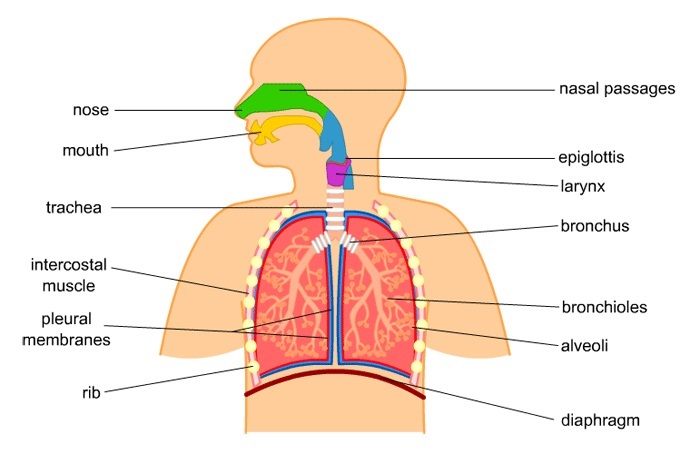
| Sketch and label the gas exchange system. |
|
| Name the components of the gas exchange system. |
• nose • mouth • trachea • bronchi (a bronchus) • bronchioles • lungs • alveoli (an alveolus) • ribcage • intercostal muscles • diaphragm |
| Why must air be drawn into the lungs constantly? |
• breathing in draws oxygen-rich air into the lungs • this creates a steep concentration of oxygen with the blood • oxygen diffuses from the alveoli into the blood continuously |
| Why must air be expelled from the lungs constantly? |
• breathing out expels carbon dioxide-rich air from the lungs • this creates a steep concentration of carbon dioxide with the blood • carbon dioxide diffuses from blood into the alveoli continuously |
| What are the lungs made up of? | clusters of alveoli connected by bronchioles |
| How are the lungs adapted for efficient gas exchange? |
• the many alveoli together provide a large surface area for gas exchange • the alveoli walls are only one cell thick to provide as short a distance as possible for diffusion • the large number of capillaries ensure a rich supply of blood to maintain a high concentration gradient |
| What is the gas content of the blood reaching the lungs? | it is always relatively low in oxygen and high in carbon dioxide |
| Describe in detail what happens in the lungs in respect to oxygen. |
• inhalation moves air containing oxygen into the alveoli • the air that enters is high in oxygen by comparison to the blood • a steep concentration gradient between the air in the alveoli and the blood in the capillaries is set up for oxygen • oxygen diffuses down the concentration gradient from the alveoli into the blood • the oxygenated blood is quickly removed from the alveoli to maintain the concentration gradient |
| Describe in detail what happens in the lungs in respect of carbon dioxide. |
• blood high in carbon dioxide is delivered to the alveoli • the air in the lungs is low in carbon dioxide by comparison to the blood • a steep concentration gradient between the air in the alveoli and the blood in the capillaries is set up for carbon dioxide • carbon dioxide diffuses down the concentration gradient from the blood into the alveoli • exhalation expels the carbon dioxide from the lungs |
| What is the advantage of having thousands of alveoli? | the many alveoli together provide a large surface area for gas exchange |
| What is the benefit of the walls of alveoli being one cell thick? | diffusion is slow and a thin wall enables it to take place as quickly as possible |
| Why are the capillaries needed by the alveoli? |
• to receive and remove oxygen quickly to maintain a high concentration gradient from the lungs to the blood • to deliver carbon dioxide continuously to the alveoli for removal by exhalation |
| Sketch a diagram showing the exchange of gases in an alveolus. |
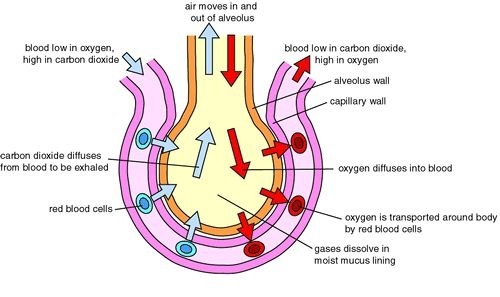
|
| Question | Answer |
|---|---|
| What is an elephant yam? |
a plant that produces a large flower that releases a smell like rotting meat to attract carrion beetles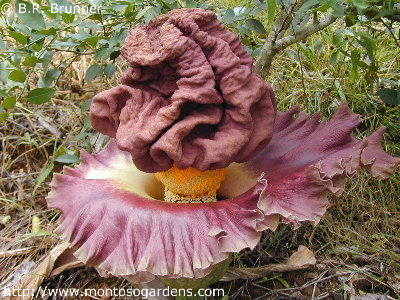
|
| What happens to the beetles when they land on the flower of the elephant yam? |
• the beetles are trapped in the flower by the slippery, waxy walls • the flower releases pollen 24 hours after it begins to smell • the beetles are coated in the pollen • the walls of the flower become rough • the beetles crawl out the flower • a second flower releases its rotting meat smell attracting the carion beetles • the pollen from the first flower is rubbed off onto the walls of the second flower pollinating it |
| Is a flower as tissue, plant organ, or plant system | a plant organ |
| What is the role of the flower in plants? | for reproduction |
| Name four organs in plants. |
• leaves • roots • stem • flowers |
| What is the function of the leaf? | to carry out photosynthesis |
| What is the function of the stem? | to support leaves and flowers |
| What is the function of the roots? | to take up water and minerals from the soil |
| List five plant tissues. |
• epidermal tissue • palisade mesophyll tissue • spongy mesophyll tissue • xylem • phloem |
| What is the function of epidermal tissue? |
• covers surfaces • provides protection • often secretes a waxy substance that waterproofs the surface |
| What is the function of palisade mesophyll tissue? | contains lots of chlorophyl to carry out photosynthesis |
| What is the function of spongy mesophyll tissue? |
• contains some chlorophyl so carries some photosynthesis • has big air spaces and a large surface area to make the diffusion of gases easier |
| Describe the function of xylem. | a transport tissue that carries water and dissolved mineral ions from the roots up to the leaves |
| Describe the function of phloem. | a transport tissue that carries disolved food around the plant |
| Where is meristem tissue found? | at the growing tips of roots and shoots |
| What is the role of meristem tissue? | it is made up of rapidly dividing plants ells that grow and differentiate into all the other cell types needed |
| List the tissues in the leaf. |
• upper epidermis • pallisade mesophyll • ploem • xylem • spongy mesophyll • lower epidermis |
| What allows gases to move in and out of the leaf? | the stomata |
| How do the stomata control the amount of gas moving in and out of the leaf? | by opening and closing the guard cells |
| Which organs contain xylem and phloem? | the leaves, stem, and roots |
| Name a plant organ system. | the whole body of the plant including the roots, the stem, and the leaves |
| Name a function of the plant organ system the body of the plant. | the transport of substances around the plant |
| What are the oldest and largest land organisms? | trees |
| Question | Answer |
|---|---|
| What do plants make during photosynthesis? | glucose |
| Where does photosynthesis take place? | in the leaves and other green parts of the plant |
| How do plants get water and mineral ions? | from the soil through the roots |
| How many transport systems does a plant have? | two |
| Name the two transport tissues in plants. | phloem and xylem |
| What does phloem tissue do? | it transports the sugars made by photosynthesis from the leaves to the rest of the plant |
| How do the growing areas of the stems and the roots get the sugars they need? | via the phloem |
| Why do the growing areas of the stems and the roots need sugars? | for building new plant cells |
| How is food transported to the storage organs? | via the phloem |
| Why do plants store food? | it provides an energy store for winter |
| Is phloem tissue live or dead? | phloem cells are alive so it is living tissue |
| What is the movement of sugars from the leaves to the rest of the plant called? | translocation |
| Name a pest that attack the phloem. | aphids like greenfly |
| How do aphids attack the plant? | they push their sharp mouthparts into the phloem and feed on the sugary liquid contents |
| What is the impact of aphids are a plant? | if too many attack a plant, they can damage even kill it |
| What does the xylem tissue do? | it carries water and mineral ions from the soil to the stem and the leaves |
| Is xylem tissue live or dead? | xylem cells start out live but die to create xylem tissue |
| In woody plants like trees, where is the xylem and the phloem | the xylem makes up the bulk of the wood and the phloem is found in a ring just underneath the bark |
| Why are young trees vulnerable to animals like deer? | if an entire ring of bark is eaten, transport in the phloem will stop and the plant will die |
| How are young trees protected in managed forests? | they have protective collars |
| Are sugars important to the plant? | they are vital for the survival and growth of the plant |
| Why do cells need sugars? | for respiration and growth |
| Why do cells need mineral ions? | for the production of other substances like proteins |
| Why does a plant need water? |
• for photosynthesis when it combines water and carbon dioxide to make glucose • to hold the plant upright |
| How does water keep the plant upright? |
• when a plant cell is full of water, the vacuole presses the cytoplasm against the cell walls • the pressure of the cystoplasm against the cell walls provides supportfor the plants |
| Question | Answer |
|---|---|
| How does air enter the leaf? | via the stomata |
| What are the stomata? | they are holes in the leaf |
| Can a plant control the amount of water leaving the leaf? | yes, by opening a closing the stomata |
| How are the stomata opened and closed? | by manipulating the guard cells |
| How do the leaves acquire carbon dioxide? | carbon dioxide from the atmosphere enters the leaf into the air spaces through the stomata, then diffuses down a concentration gradient into the cells of the leaf |
| How is oxygen produced during photosynthesis removed from the leaf? | oxygen diffuses from leaf cells into the air spaces in the leaf and then diffuses out the leaf through the stomata |
| How is water lost by a plant? | the water evaporates from the cells lining the air spaces and then passes out the leaf via the stomata |
| What is the loss of water via the leaves called? | transpiration |
| What happens when water is lost from the leaves via the stomata? | water is pulled up from the roots through the xylem to the leaves to replace the lost water |
| What is the water pulled up from the roots to the leaves through the xylem called? | the transpiration stream |
| What drives the transpiration stream? | the evaporation of water through the leaves |
| Question | Answer |
|---|---|
| List 4 factors that affect the rate of transpiration. |
• temperature • humidity • light intensity • air flow |
| Is there a link between factors affecting the rate of photosynthesis and transpiration? | Anything that increases the rate of photosynthesis will increase the rate of transpiration |
| Why does photosynthesis affect the rate of transpiration? | when the rate of photosynthesis increases, it opens the stomata more to let in more carbon dioxide and this allows more water to escape the leaf |
| What is the effect of light intensity on transpiration? | an increase in light intensity causes an increase in photosynthesis and thus an increase in transpiration |
| How do hot conditions affect transpiration? | more water evaporates and diffusion happens quicker thus increasing the rate of transpiration |
| How do dry conditions affect transpiration? | water vapour diffuses more rapidly into dry air than humid because the concentration gradient is steeper and thus increases the rate of transpiration |
| How do windy conditions affect transpiration? | windy conditions maintain a high concentration gradient by moving water vapour rapdily as it evaporates thus increase the rate of transpiration |
| How does temperature affect the rate of transpiration? |
an increase in temperature, increases the rate of transpiration for two individual reasons • as temperature increases, the molecules move faster so diffusion speeds up • as temperature increases, photosynthesis speeds up so the stomata open more to allow in more carbon dioxide |
| Name two adaptations that help to reduce transpiration while photosynthesis takes place. |
• a waxy cuticle on the top of the leaf • stomata on the underside of the leaf |
| How does the waxy cuticle reduce transpiration? |
• the waxy cuticle is waterproof preventing water from evaporating from the leaf • the waxy cuticle is on the top of the leaf where the light strikes heating water in the leaf |
| How does stomata on the underside of the leaf reduce transpiration? | the underside of the leaf is not exposed to direct sunlight |
| What happens if the plant loses water faster than it is replaced by the roots? |
• the plant may wilt • the stomata close |
| What happens when a plant wilts? | the leaves collapse and hang down reducing the surface area from which water can evaporate |
| What is the effect of closing stomata? |
• water is prevented from escaping from the leaf via the stomata • photosynthesis slows down as the supply of carbon dioxide is shut off • the plant may overheat as evaporation enables the plant to get rid of excess heat |
| When the plant no longer wilt? | until it rains, night falls, or the temperature drops, the plant will remain wilted |
| What equipment is used to investigate the rate of transpiration? | a potometer |
| What does a potometer do? | it can be used to show how the update of water in a plant changes in different conditions |
| How much of the water taken up by a plant is lost through transpiration? | almost all the water taken up by a plant is lost through transpiration |
A good tutor can build the confidence of a learner enabling subject success
A private tutor can improve the skills a pupil needs to master a subject
Regular tutoring can drive progress and better results in school subjects
Support can help students and parents make the right academic decisions