KS Learning can provide extra lessons for maths from gcse maths tutors in London and help with gcse maths past papers, gcse maths revision notes, and gcse maths revision worksheets. Maths private tuition at its tuition centre can improve maths knowledge and performance through maths lessons, mathematics tutorials and maths tuition Twickenham.
| Question | Answer |
|---|---|
| What is meant by the internal environment of the body? | the conditions inside the body like pH and temperature |
| What is homeostasis? | the regulation of the internal conditions of an organism to maintain optimum conditions for function in response to internal and external changes |
| How do humans survive in conditions from the cold Arctic to the hot Saharan desert? | homeostasis keeps conditions inside the body steady so organs and enzymes can function properly despite external conditions |
| What controls the functions of the cell? | enzymes control all the functions of the cell |
| Why is homeostasis important to enzymes? | enzymes work best in specific conditions which homeostasis maintains |
| Why is homeostasis important for cell functions? | cell functions require specific conditions to operate and homeostasis maintains these specific conditions |
| Name the internal conditions controlled in the human body. |
• body temperature • the water content of the body • blood glucose concentration |
| What is responsible for detecting and responding to changes in the body? | automatic contol systems |
| Name the key components of an automatic control system. |
• receptors • coordination centres • effectors |
| Give examples of things included in automatic control systems? | they include nervous responses in the nervous system, chemical responses in the hormone system, and the organs of the body |
| What might happen to the organs if the internal environment kept changing? | the organs may • function poorly • stop functioning • be damaged permanently, or • fail completely |
| What are receptors? | cells that detect changes in the internal and external environment |
| What are changes in the internal and external environment called? | stimuli |
| What do coordination centres do? |
• they receive information from the receptors • they process information from the receptors • they send out signals to coordinate the response of the body |
| Name a coordination centre. | the brain |
| What does the brain coordinate? |
• the nervous system • parts of the hormonal system • the spinal cord • the pancreas |
| What are effectors? | muscles or glands that bring about changes to received stimuli |
| What is achieved by the actions of effectors? | they restore conditions in the body to the optimum levels |
| Question | Answer |
|---|---|
| What does the nervous system enable an organism to do? | it enables an organism to monitor the surroundings then respond and cooridinate the response |
| What is carried by the nervous system? | electrical impulses |
| What is the speed of electrical impulses in the nervous system? | between 1 and 120 metres per second |
| How are changes in the surroundings detected by a person? | using cells called receptors |
| What are changes in the surroundings called? | stimuli (one stimulus) |
| Describe receptor cells. |
• there are many different types of receptor cells • they are similar to most animal cells • they have a nucleus, cytoplam and a cell membrane • they are usually found clustered together in special sense organs |
| List five special sense organs that contain sensory receptors. |
• ears • eyes • skin • nose • tongue |
| Give an example of sense organs operating in an animal. | male moths to detect the scent of a female, sometimes many kilometres away |
| Describe the sense organ sensitive to sound. | ears |
| What receptors are in the eyes? | receptors sensitive to light |
| What external stimuli do the ears respond to? |
• sound for hearing • changes in position for balance |
| Which receptors assist with balance? | sensory receptors in the ears monitor change in position for balance |
| What are the sense roles of the nose and the tonguer? | they contain receptors sensitive to chemicals for taste and smell |
| What happens when a sensory receptor detects a stimulus? |
• the sensory receptor initiates an impulse (electrical signal) • the impulse travels along sensory neurones until it reaches the central nervous system (CNS) • the CNS processes the information and coordinates the response • the CNS sends an impulse along motor neurones to the effectors • the effectors respond as required by the CNS |
| Draw a graph to show the path of an impulse from stimulus to the completed action. | stimulus → receptor → sensory neurone → CNS → motor neurone → effector |
| What is a nerve? | a bundle of hundreds or thousands of neurones |
| What is the CNS | the CNS is made up of the brain and the spinal cord |
| What are effectors | they respond to impulses sent from the CNS and can be muscles or glands |
| How do muscles respond to a stimulus? | they contract |
| How do glands respond to a stimulus? | they secrete chemicals |
| List two glands with a stimulus and their response. |
• the salivary glands produce and release saliva in response to the smell of food cooking • the pancreas releases the hormone insulin when blood sugar levels rise after a meal |
| Label a sensory neurone. | 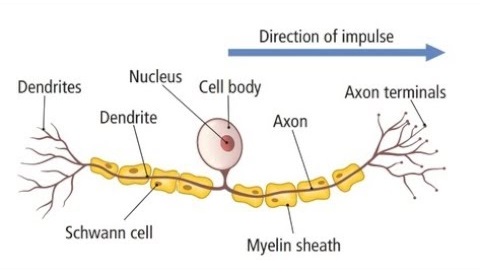
|
| Label a motor neurone. | 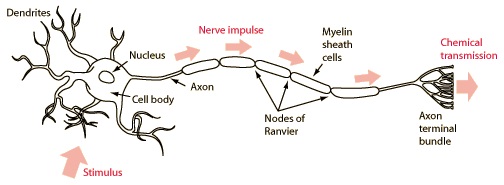
|
| Question | Answer |
|---|---|
| What is a quick, automatic response called? | a reflex |
| List 3 examples of reflex actions. |
• pulling back when touching something hot • blinking when something comes near your face • jumping when you get a fright |
| What is the purpose of quick reflex actions? | they help to avoid danger and harm by happening quickly and without conscious thought |
| What are the two purposes of reflex actions? |
• quick reactions to avoid danger and harm • taking care of basic body functions |
| Name two basic body functions that are reflex actions. |
• breathing • moving food through the intestines |
| List the charateristics of reflex actions. |
• automatic • rapid • without conscious thought |
| Name the neurones involved in a reflex action. |
• sensory neurone • relay neurone • motor neurone |
| What is a relay neurone? | they are found in the CNS and connect sensory neurones to motor neurones |
| Describe the pathway that the electrical impulse follows in a relay action. |
• the impulse from the receptor down the sensory neurone • it then passes along the relay neurone usually in the spinal cord • finally it travel through the motor neurone to the effector organ |
| What is the pathway called that the impulse follows in a reflex action? | a reflex arc |
| Why does the impulse in a reflex response bypass the conscious brain? | to make the time between the stimulus and the reflex response as short as possible |
| What is found between the 3 types of neurones in the reflex arc? | there is a physical gap called a synapse - the neurones do not touch |
| What mechanism is used by an impulse to travel across the synapse to reach the next neurone? | chemicals are used cross the synapse |
| Describe the chemical process used by an impulse to travel across the synapse. |
• the impulse arrives at the junction of the neurones • chemicals are released by the neurone • chemicals cross the synapse • the chemicals arrive at receptor sites • a new impulse is generated |
| How does the speed of the electrical impulse compare with the speed of the chemical diffusion in the synapse? | the electrical impulse is much faster than chemical diffusion across the synapse |
| Describe in detail what happens when you touch a hot object. |
• a receptor is stimulated when a hot object is touched • an impulse is generated by the receptor • the impulse travels down the sensory neurone • the impulse in the sensory neurone arrives at the synapse • a chemical is released • the chemical diffuses across the synpase • the chemical reaches the relay neurone where it generates a new impulse • the impulse travels along the relay neurone • the impulse reaches the synapse between the relay and motor neurone • a chemical is released into the synapse, diffuses across it, and generates a new impulse in the motor neurone • the impulse travels down the motor neurone • the impluse reaches the effectors in the arm muscle • the muscle contracts • the hand is moved away from the hot object |
| What is the difference between the pathway in a reflex action and a conscious action? | in a reflex action, the cooridnator is a relay neurone in the spinal cord or the uncounscious area of the brain |
| When do you become aware of a reflex action? |
• at the same time that the impulse is sent down the motor neurone, and impulse is also sent to the conscious brain • the person thus becomes aware of the reflex action but only after it has happened |
| Question | Answer |
|---|---|
| Where does information collected by the sensory receptors finish? | it all ends up in the brain |
| What does the brain do with the information it receives? | it processes the information and then sends out the impulses to co-ordinate a response to the specific situation |
| What does the brain control? | everything from walking to thoughts and feelings |
| How is the brain protected? |
• by the bones of the skull • it is encased in protective membranes called the meninges |
| What is the texture of the brain? | it can be described as being like set yoghurt |
| What is the brain made uo of? | billions of interconnected neurones organised into regions |
| What is the purpose of the different regions? | each region performs specific functions |
| Name five key regions in the brain. |
• the cerebral cortex • cerebellum • the medulla • hypothalamus • pituitary gland |
| What is the function of the cerebral cortex? | it is concerned with consciousness, intelligence, memory, and language |
| What is the function of the cerebellum? | it is concerned with coordinating muscular activity and balance |
| What is the function of the medulla? | it is concerned with unconscious activities such as controlling the heartbeat, the movements of the gut, and breathing |
| What is the function of the hypothalamus? | it is involved in controlling body temperature |
| What is the function of the pituitary gland? | it is plays a big part in controlling and coordinating body systems |
| What provided early evidence for the roles of different areas of the brain? | people suffereing brain damage; by matching changes in behaviour or memory with the damaged area has enabled scientists to map the functions of some parts of the brain |
| What important brain damage incident helped scientists understand the brain in 1848? | an explosives accident blew an iron rod through the skull of 25-year-old Phineas Gage |
| How did the rod through his brain affect Phineas Gage? | before the accident he was polite and hardworking and afterwards he became wild, rude, and unreliable | `
| What is it believed caused the change in Phineas Gage's personality? | modern scans show that the accident removed part of his cerebral cortex, including the area that controls social inhibitions |
| Name four techniques enable scientists to study the brain. |
• studying people with brain damage • electrically stimulating different parts of the brain • MRI scans • problems with the brain |
| How do scientists gain access to the brain to stimulate it for research? | by removing the top of the skull |
| What effect of stimulating different areas of the brain? | people can experience hunger, thirst, anger or fear just by stimulating the relevant area of the brain |
| Why is surgery usually done on conscious patients? | there are no sensory nerve endings in the brain |
| What does MRI stand for? | magnetic resonance imaging |
| What do MRI scans allow scientists to do when studying the brain? | they can take pictures of brain activity on live patients |
| Make two medical conditions of the brain affect behaviour? | a stroke or a tumour |
| Why are MRI scans of patients with a brain tumour or after a stroke useful to scientists studying the brain? | they show which areas of the brain have been affected allowing scientists to link parts of the brain to changed function and behaviour |
| How else are MRI scanners used to understand the brain? | MRI scanners can take pictures of brain activity while a person performs a task |
| What are the challenges with studying and treating the brain? |
• it is very complex with billions of neurones • it is very delicate so easily damaged • many processes involve large numbers of neurones in many different areas • there are a range of chemicals like hormones that affect the behaviour of the neurones in the brain |
| Question | Answer |
|---|---|
| What is the eye? | it is a sense organ containing receptors in the retina that are sensitive to light intensity and colour |
| Where are the light sensitive cells? | at the back of the eye in a light-sensitive layer known as the retina |
| What is the sclera? | the white outer layer of the eye |
| What is the main property of the sclera? | it is tough and strong so the eyeball is not easy to damage |
| What is the cornea? | it is a transparent area in the sclera at the front of the eyeball |
| What is the function of the cornea? |
• it lets light into the eye • it bends the direction of the light to focus them on the retina |
| What does the iris do? | it is made of muscles that contract and relax to regulate the amount of light reaching the retina through the pupil |
| What happens to the iris in bright light? | the circular muscles contract and the radial muscles relax in the iris so the pupil constricts and reduces the amount of light entering the eye |
| Why does the pupil become small in bright light? | to reduce the amount of light entering the eye because too much light can damage the delicate, light-sensitive cells |
| What happens to the iris in dim light? | the circular muscles relax and the radial muscles constrict in the iris so the pupil dilates and increases the amount of light entering the eye |
| What does light pass through after the pupil? | a clear disc called the lens |
| How is the lens held in place? | by suspensory ligaments and the ciliary muscles |
| What is the role of the lens? | it focuses the light on the retina to produce a clear image |
| What fills the eyeball? | a clear transparent jelly that maintains its spherical shape |
| What happens when light hits the retina? | the light sensitive cells are stimulated sending impulses to the brain along sensory neurones in the optic nerve |
| What is the blind spot? | the point where the optic nerve leaves the eye |
| Why does the blind spot not create a hole in what people see? | the brain fills in the space completing the picture |
| What is the function of the optic nerve? | it carries impulses from the retina to the brain |
| Why does light entering the eye need to be focused? | to be able to see clearly |
| What happens if the light is not focused on the retina? | the image will be blurred if the light is focused in front of or behind the retina |
| What is the process called that focuses light in the eye? | refraction |
| What is refraction? | it refers to changing the direction of light |
| What parts of the eye refract the light that enters? | the cornea, the lens and the jelly of the eyeball |
| How does the eye focus light? | the shape of the lens of the eye can change shape by the contraction and relaxation of the ciliary muscles |
| What is the effect of changing the shape of the lens of the eye? | it changes the amount the eye refracts light |
| How does the image appear on the retina? | it is upside down |
| Why do we not see images upside down when the image on the retina is upside down? | the brain turns the image upright |
| Question | Answer |
|---|---|
| What is accommodation in the eye? | the process of changing the shape of the lens of the eye to focus on near or far or distant objects |
| Describe the light that reaches the eyes from close objects? | the light is spreading out or diverging very strongly |
| Describe the light that reaches the eyes from distant objects? | the light is travelling in almost parallel rays |
| What does the cornea do? | it refracts (changes the direction) of the light entering the eyes towards the retina |
| What does the lens do? | the lens makes it possible to see close and distant objects equally well by changing shape to focus light on the retina |
| How does the eye see distant objects? |
• the ciliary muscles relax • this pulls the suspensory ligaments tight • which pulls the lense thin and flat • only causing light to be slighted refracted • it focuses the light on the retina |
| How does the eye see near objects? |
• the ciliary muscles contract • this lets the suspensory ligaments loosen • so the lens thickens and more curved • causing light to be strongly refracted • it focuses the light on the retina |
| Why are older people more likely to need glasses> | the lens of the eye hardens making accommodation more difficult |
| Name two common eye defects. |
• myopia - short sightedness • hyperopia - long sightedness |
| What is the effect on sight of both myopia and hyperopia? | the rays of light are not focused on the retina so the image is blurred |
| What can and can't you see with myopia? | it is possible tp see close objects clearly while distant objects are blurred |
| Why are distant objects blurred with myopia? | light is focused in front of the retina so the images that reach the retina are out of focus |
| Name two possible causes of myopia. |
• a long eyeball • the lens is too curved |
| What is the most common way of treating myopia? | wearing glasses with a concace lens |
| How does wearing glasses with concave lenses help with myopia? | it spreads out light before it reaches the eye |
| What can and can't you see with hyperopia? | it is possible to see distant objects clearly while close objects are blurred |
| Why are near objects blurred with hyperopia? | the lens cannot bend the light strongly enough it is focused behind the retina so the images that land on the retina are out of focus |
| Name two possible causes of myopia. |
• a short eyeball • the lens is too flat and too thin |
| What is the most common way of treating hyperopia? | glasses with convex lenses |
| How does wearing glasses with convex lenses help with hyperopia? | the lenses bring the light rays closer together before they reach the eye so the lens can bring the image into perfect focus |
| Name three new methods of overcoming myopia and hyperopia. |
• contact lenses • laser eye surgery • replacement lenses |
| Where are contact lenses placed? | on the surface of the eye |
| What do they do different to glasses? | they work the same way as conventional glasses |
| What is the advantage of contact lenses? | they cannot be seen and make activities like doing sport much easier |
| Describe hard contact lenses? |
• they are made of a hard material • they are rigid • they last a long time • they have to be removed overnight • they have to kept sterile to avoid eye infections |
| What are the most modern contact lenses like? | they are soft |
| What are the advantages of soft contact lenses? | they are made of more flexible material making them more comfortable to wear |
| What are the disadvantages of soft contact lenses? | they do not last as long |
| Describe the different types of soft contact lenses |
• some soft lenses can be worn every day for a month - they must be soaked in sterile solution overnight • some soft lenses are disposable - worn for a day and thrown away |
| When can a person have laser eye surgery? | it is only available to adults once their eyes have stopped growing and their vision has become stable |
| How are lasers used to treat myopia? |
• to reduce the thickness of the cornea so it reflects the light less stronglybr>
• so distant light is focused on the lens and instead of in front of tbe lens |
| How are kasers used to treat hyperopia? | to change the curve of the cornea so it refracts light from close objects more effectively |
| What is done when replacment lenses are used to treat myopia or hyperopia? | another lens is added inside the eye to correct the visual defect permanently |
| Describe the two main techniques that are used with replacement lenses. |
• the permanent contact lens is implanted into the eye and the natural lens is left in place • the faulty lens is replaced by an artificial lens |
| What are the risks of lens replacement? |
• damage to the retina • cataracts developing if the natural lens is left in place • infections |
A good tutor can build the confidence of a learner enabling subject success
A private tutor can improve the skills a pupil needs to master a subject
Regular tutoring can drive progress and better results in school subjects
Support can help students and parents make the right academic decisions