KS Learning can provide extra lessons for maths from gcse maths tutors in London and help with gcse maths past papers, gcse maths revision notes, and gcse maths revision worksheets. Maths private tuition at its tuition centre can improve maths knowledge and performance through maths lessons, mathematics tutorials and maths tuition Twickenham.
| Question | Answer |
|---|---|
| Define the density of a substance | the density of a substance is the mass per unit volume |
| What are the units of mass? | kilograms (kg) |
| What are the units of volume? | cubic metres (m3) |
| What are the units of density? | kg.m-3 |
| Write the word equation for density. | density = mass divide volume |
| Write the symbol equation for density. | ρ = m / V |
| How many g in a kg? | 1000g in 1kg |
| How many cm in a m? | 100cm in a metre |
| How many cm2 in a m2? | 100x100 = 10 000 cm2 in 1 m2 |
| How many cm3 in a m3? | 100x100x100 = 1 000 000 cm3 in 1 m3 |
| Find the density of wood with a mass of 8kg and a volume of 25 000cm3. | volume = 25 000cm3/1 000 000 = 0.025 m3 density = 8 kg / 0.025m3 = 320 kg/m3 |
| How is the mass of an object measured? | using an electronic balance |
| What must be done before using an electronic balance to measure mass? | the electronic balance must read zero |
| Name three items that can be used to measure the dimension of regular solids? |
• a ruler • vernier callipers • a micrometer |
| How can the volume of an irregular solid be measured? |
• partly fill a measuring cylinder with water • lower the the object on a thread into the water • measure the rise in the water level • the rise in the water level is the volume of the solid |
| How can the mass of a liquid be measured? |
• measure the mass of an empty beaker using a balance • pour the liquid into the beaker and measure the mass again • the difference between the two readings is the mass of the liquid |
| What substances float in water? | substances with a lower density than water will float |
| Question | Answer |
|---|---|
| Name the three states. | solid, liquid, or gas |
| Which states of matter can flow? | only liquid and gas, not solid |
| How does density change with state? | solids are usually more dense than liquids, and liquids are usually more dense than solids |
| What determines the volume in each state? | solids and liquids maintain a fixed volume while gases change volume to fill a container or space |
| What determines the shape of each state? | a gas fills the container it is in and takes on the containers shape, a liquid fills the bottom of the container taking on its shape, and solids have their own shape independent of the container |
| What type of change occurs when a substance changes state? | a physical change |
| Why is water turning from liquid to vapour a physical change? | because there are no new substances formed during the change of state |
| What happens to the substance when a physical change is reversed? | the substance regains its original properties |
| How can one change the state of a substance? | by heating or cooling the substance |
| What happens when water boils? | the liquid water changes to water vapour - there is a change of state from liquid to gas |
| What happens when dry ice warms up? | dry ice (solid carbon dioxide) turns directly to gas |
| What happens when steam touches a window? | the steam condenses and turns into water |
| What does the conservation of mass say about a substance changing state? | the mass of the substance after the change of state is the same as the mass of the substance before the change of state |
| Draw a change of state diagram labelling each change of state. |

|
| Describe the particles of a substance in its solid state. |
• they are held in fixed positions next to each other • they vibrate about their fixed positions • a sold thus has a fixed shape |
| Describe the particles of a substance in its liquid state. |
• they are in contact with each other • they move at random • a liquid thus does not have a fixed shape and can flow • a liquid takes the shape of the botton of its containers |
| Desribe the particles of a substance in its gaseous state. |
• the particles move about at random • the particles move much faster than in a liquid • the particles are much further apart than they are in a liquid • the density of a gas is thus much lower than a liquid or a solid • a gas thus does not have a fixed shape but fills the contain it is in |
| What happens to the particles in a substance when it is heated? | the particles move faster |
| How does the energy of the particles compare in each state? | the particles in a liquid have more energy than in a solid, and the particles in a gas have more energy than in a liquid |
| Question | Answer |
|---|---|
| What is the temperature of ice and water as the ice melts in a beaker over a bunsen burner? | the ice and the water remain at 0 °C until all the ice is melted |
| What temperature does water boil at at atmospheric pressure? | 100 °C |
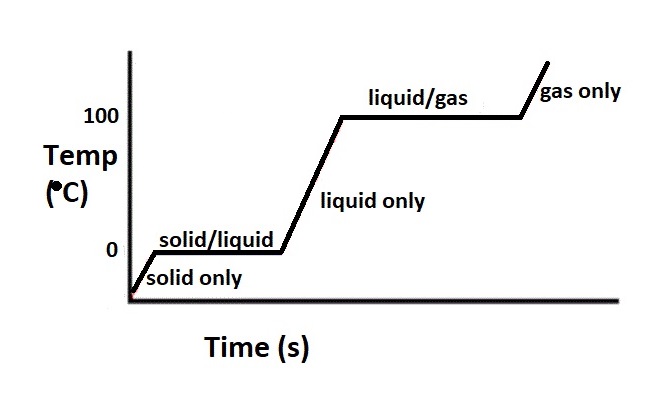
| What happens to the temperature of a substance while it is changing state? | the temperature remains constant while a substance changes its state for both states present |
| What is the temperature at which a liquid changes state to a solid called? | the freezing point of the substance |
| What is the temperature at which a solid changes state to a liquid called? | the melting point of the substance |
| What do the freezing point and the melting point of a substance have in common? | they are the same temperature |
| What is the temperature at which a liquid changes state to a gas called? | the boiling point of the substance |
| What is the temperature at which a gas changes state to a liquid called? | the condensation point of the substance |
| What do the boiling point and the condensation point of a substance have in common? | they are the same temperature |
| Will impurities affect state changes? | yes, impurities change the temperature at which state changes happen |
| What happens to the melting point of water if the water contains salt? | the melting point is lowered |
| Sketch a graph of temperature for water changing from solid to liquid then liquid to gas over time. |
|
| Describe what happens to temperature when ice is heated from below 0 °C to over 100 °C . |
• the temperature of the ice will increase until it reaches 0 °C • at 0 °C the ice will begin to melt and water will appear • the ice and water mixture during melting will remain at 0 °C until all the ice is melted • the temperature of the water increases from 0 °C until it reaches 100 °C • at 100 °C the water boils and water vapour appears • the water and vapour mixture during boiling will remain at 100 °C until the water has boiled away • the temperature of the water vapour increases above 100 °C |
| Why does the temperature of the mixture of ice and water not change temperature even though heat is being added constantly? | the energy being added is being used to break the bonds of the ice to form water rather than to change the temperature |
| What is the energy called that is added to a substance as it changes state? | the latent heat |
| When does evaporation happen? | it happens at all temperatures below the boiling point |
| What is the difference between evaporation and boiling? | evaporation happens at all temperatures below the boiling point and only at the surface of the liquid whereas boiling happens only at the boiling point throughout the entire liquid |
| Question | Answer |
|---|---|
| What happens to the molecules in water as its temperature increases until it boils? |
• the molecules of the water gain energy as the temperature increases • the molecules of the water move faster as the temperature increases • when the molecules of the water have enough energy to move away from each other, the water boils • the water turns into water vapour |
| What is the energy stored by the particles of a substance called? | the internal energy of the substance |
| What causes the internal energy of a substance? | the motion and position of the particles in the substance |
| What is the internal energy of a substance made up of? | the internal energy of the particles is the sum of • the kinetic energy they have because of their motion • the potential energy they have because of their positions |
| Define internal energy. | the total energy in the kinetic and potential energy stores of all the particles in the substance due to their individual motions and position |
| What is the impact of the gravitational potential energy of a substance as a whole on the internal energy of a substance? | none - internal energy does not include gravitational potential energy of the substance as a whole |
| What is the impact of the kinetic energy of a substance as a whole on the internal energy of a substance? | none - internal energy does not include the kinetic energy of the substance as a whole |
| What is the impact of heating on internal energy? | heating increases the internal energy of the substance by increasing the energy of its particles |
| What happens to the internal energy when the temperature of a substance increases? | the total kinetic energy of the particles increases |
| What happens to the internal energy when a substance changes state? | the total potential energy of the particles increases |
| How can the change of energy be calculated when the temperature changes? | ΔE = mcΔθ where E is energy m is mass c is specific heat capacity θ is temperature |
| What determines whether a substance is solid, liquid or gas? | the strength of the forces of attraction between the particles |
| Describe the behaviour of the particles in a solid. |
• there are strong forces of attraction between the particles • the strong forces of attraction bond the particles in fixed positions • each particle vibrates about an average position that is fixed • when heated, the particles vibrate more • when heated, the particles energy stores increase • if heated enough, the particles gain enough energy to break away from the structure and the solid melts |
| Describe the behaviour of the particles in a liquid. |
• the forces of attraction in a liquid are weaker than in a solid • the forces of attraction in a liquid are not strong enough to hold the particles in a rigid structure • the forces of attraction in a liquid are strong enough to prevent the particles from moving away from each other • when heated, the particles move faster • when heated, the particles energy stores increase • when heated but before boiling, some of the particles gain enough energy to break away from the liquid - evaporation • if heated enough, the particles gain enough energy to break away free from the liquid and the liquid boils |
| Describe the behaviour of the particles in a gas. |
• the forces of attraction between the particles are so weak that they are insignificant • the particles move about at high speeds • the particles move in random directions • the particles collide with each other and the surface of the container • when heated, the particles of a gas gain kinetic energy • when the particles gain kinetic energy, they move faster on average • when the particles move faster, they collide more often with the surface |
| What causes the pressure a gas exerts on a surface? | the pressure of a gas is caused by the force of impacts on the surface |
| What is the impact on the pressure exerted by a gas of an increase in temperature? | pressure increases |
| Why does the pressure exerted by a gas increase with temperature? | because the particles of the gas move faster and collide more often with the surface |
| Question | Answer |
|---|---|
| What happens to a solid if it is heated at its melting point? | it changes to a liquid maintaining the temperature until all the solid is melted |
| What happens to the temperature of a substance while it melts? | the temperature remains constant at the melting point until all the solid has melted |
| What is the energy called that is supplied to change a solid to a liquid? | the latent heat of fusion |
| What is latent heat? | the energy needed for a substance to change its state without changing its temperature |
| What temperature will a liquid solidify at? | the same temperature as it melts |
| What happens to the temperature of a liquid as it solidifies? | the temperature remains constant at the melting point until all the liquid has become solid |
| What happens to the energy of the particles as it solidifies? | the latent heat of the substance is transferred to the surroundings and the particles form stronger bonds |
| Define specific latent heat of fusion. | the specific latent heat of fusion Lf of a substance is the energy needed to change the state of of 1kg of the substance from solid to liquid without changing its temperature |
| What is the unit of specific latent heat of fusion. | the joule per kilogram (J/kg) |
| State the equation for the specific latent heat of fusion with symbols and units. | \( {specific\; latent\; heat\; of\; fusion,\; L_f\; (J/kg)} = \frac {energy,\; E\; (joules,\; J)}{mass,\; m\; (kilograms,\; kg)} \) |
| What happens when a liquid is heated to its boiling point? | at the boiling point, the liquid boils, and the liquid turns to vapour |
| What is the energy called that transforms a liquid to vapour? | the latent heat of vaporisation |
| What is the latent heat of vaporisation? | the energy needed by the particles to break away from the neighbouring particles in a liquid |
| What happens when a vapour is cooled to its boiling point? | the vapour will become a liquid again |
| What happens to the latent energy in the vapour as it becomes liquid? | the latent heat is transferred to the surroundings as the particles form new bonds |
| Define the specific latent heat of vaporisation. | the specific latent heat of vaporisation of a substance is the energy needed to change the state of 1kg of the substance from vapour to liquid without changing its temperature |
| What is the unit of specific latent heat of vaporisation. | the joule per kilogram (J/kg) |
| State the equation for the specific latent heat of vaporisation with symbols and units. | \( {specific\; latent\; heat\; of\; vaporisation,\; L_v\; (J/kg)} = \frac {energy,\; E\; (joules,\; J)}{mass,\; m\; (kilograms,\; kg)} \) |
| Question | Answer |
|---|---|
| Why should one never heat food in a sealed can? | the pressure of the gas in the can will increase as the temperature increases causing the can to explode |
| How does a gas in a container create pressure? |
• the particles of the gas collide repeatedly with the container at random • each collision exerts a tiny force on the surface • millions of these tiny forces occur every microsecond • the cumulative effect of all the tiny forces creates a steady pressure |
| What causes the pressure of a gas? | the random impacts of gas molecules on surfaces in contact with the gas |
| What is the pressure of a gas? | the total force per unit area on a surface |
| What are the units of pressure? | Pascals, Pa |
| What is the effect of increasing the temperature of a gas in a container? | it increases the pressure exerted by the gas in the container |
| Why does the pressure exerted by a gas in a container increase when the gas is heated? |
• the energy transferred to the gas increases the kinetic energy of the particles • this increases the speed of the particles • so the particles hit the container more often and harder |
| Why can the movement of gas particles not be seen directly? | they are too small |
| How can the movement of gas molecules be observed indirectly? | using smoke particles in air |
| Describe the movement of smoke particles. | the smoke particles move haphazardly and follow unpredictable paths |
| Why causes the smoke particles to move haphazardly? | the random impacts of the air particles on each smoke particle |
| How do we known that the air molecules are moving fast? | the smoke particles are huge by comparison to the air particles so the air particles must be moving very fast |
| Question | Answer |
|---|---|
| What two factors affect the pressure of a gas? | volume and temperature |
| How does compressing a gas affect its volume? | compressing decreases the volume of the gas |
| How does the expansion of a gas affect its volume? | expansion of a gas increases the volume of the gas |
| If a gas is compressed, other than volume, what will change? | the temperatue and pressure of the gas will both increase |
| If a gas is expanded, other than volume, what will change? | the temperature and pressure of the gas will decrease |
| What causes pressure from a gas? | air particles striking the walls of the container which produces a force at 90 degrees to the walls of the container |
| What is a piston? | an air-tight sliding piece that fits in a cylindrical chamber and designed to move back and forth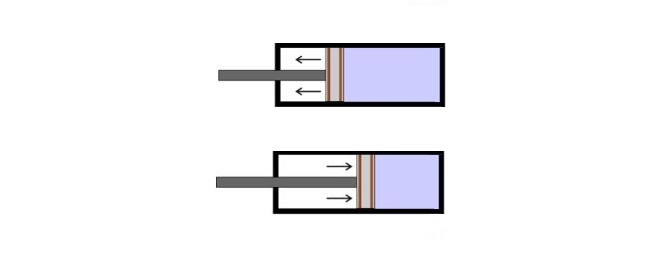
|
| When a piston is pushed into a tube of air, what happens to the air? | the pressure of the air increases as the air is compressed and the volume decreases |
| What happens to temperature of the air in the piston in the above question if the compression happens very slowly? | if, and only if, the compression happens very slowly, the temperature of the air will not change noticeably |
| How is a piston pushed into a tube? | a force is applied to the piston |
| What happens when a force is applied to a piston to compress the air in the tube? | work is done to the air, in other words, energy is transferred |
| Why is a force needed to compress air in a piston? | the applied force is needed to overcome the force that is caused by the pressure of the enclosed gas in the tube |
| What happens if the compression does not happen slowly? | the work done on the gas would increase its internal energy store and its temperature |
| Why does the temperature of the gas not increase if the compression happens slowly? | the gas loses energy by heating its surroundings at the same rate as energy is transferrred into it |
| What happens to the internal energy store of a gas as it is compressed? | if compressed quickly, the internal energy store increases, but if compressed slowly, the interal energy story may not change if the gas transfers energy to the surroundings at the same rate as energy is transferred to it |
| What are the units of • pressure of air • volume of air |
• Pascals (Pa) • m3 |
| Name a piece of equipment used to measure pressure. | a pressure guage |
| What can a foot pump be used to do? | to increase air pressure |
| What is the value of atmospheric pressure? | 101 kPa |
| What causes atmospheric pressure? | The air has weight, and it pushes down on the earth and things on the earth. That pressure is called atmospheric pressure. In other words, atmospheric pressure is the force exerted on the earth surface and objects on the objects on the earth by the air above it as gravity pulls it to Earth. |
| Does the number of gas molecules change in a fixed mass of gas? | No, the number of gas molecules is constant for a fixed mass of gas |
| How does the average speed of the molecules change for a fixed mass of gas if the temperature is constant? | the average speed of the molecules is constant if the temperature is constant |
| If the volume of a fixed mass of gas at a constant temperature is reduced, what happens to the pressure of a gas? | the gas pressure increases |
| Why does the gas pressure increase, if the volume of a fixed mass of gas at a constant temperature is reduced? |
• the space the molecules move in is smaller • the molecules hit the surfaces more often |
| Why does gas pressure increase when the space the gas molecules move in, is decreased? | the gas molecules don't travel as far between each impact between so hit the surfaces more often |
| Why does gas pressure increase when the molecules hit the surfaces more often? | when the gas molecules hit the surfaces more often, the number of impacts per second increases so the total force of the impacts per square metre of surface area increase |
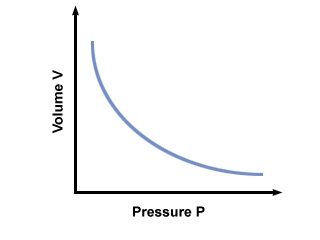
| State Boyle's Law | if the mass and temperature of a gas is constant, pressure (p) x volume (V) = constant |
| Rearrange Boyle's Law for pressure. | p = constant / V |
| Rearrange Boyle's Law for volumes. | V = constant / p |
| What is the relationship between pressure and Volume for a gas of constant mass and temperature. | pressure is inversely proportional to volume |
| Sketch pressure versus volume for gas of constant mass and temperature. |
|
A good tutor can build the confidence of a learner enabling subject success
A private tutor can improve the skills a pupil needs to master a subject
Regular tutoring can drive progress and better results in school subjects
Support can help students and parents make the right academic decisions